

Teapot [Satsuma-ware], Japanese, 19th Century, Ceramic. Flint Institute of Arts (Flint, Michigan).
(Gift of Midd Angelina Simonson)
01
Satsuma-ware Teapot
This 19th century teapot from Japan is a type of ceramic style known as Satsuma-ware. Satsuma-ware is identifiable by its off-white colored body and transparent glaze, often decorated by motifs of birds and flowers in colors of blue, green, pink and gold. Like the delicate and detailed birds and flowers on this teapot, Satsuma decoration is often done in miniature. The simplicity of its design most likely identifies this teapot as a late-Edo period (1603 – 1868 CE) ceramic.
Satsuma-ware has a long history, and this style was first developed by Korean potters living in the Satsuma province of Japan during the 16th century. Satsuma-ware was particularly popular in the late 19th to early 20th century when Japan began trading with the West.
02
Blue and White Bowl
This porcelain dish from the Late Edo Period is a perfect example of Edo period (1603 – 1868 CE) cultural aesthetics. During this time, artists would often experiment and play with form, often blending together an object’s design with its intended use. This dish features a large, finely detailed fish and a wave design along the outer edge. Here, the plate acts as a window into the ocean or river: the viewer peers through the rippling waves on the edge to glimpse the fish hidden in the water grasses. At the same time, this dish may have been used as tableware for a wealthy or powerful family; If fish were served on the plate, it would be as if the user would “catch” the fish straight out of the water.

Japanese, 19th century, ca. 1800, Late Edo Period. Porcelain. 2 9/16 × 15 7/8 in. (6.5 × 40.3 cm). Flint Institute of Arts (Flint, Michigan).
Gift of Mr. and Mrs. Thomas Soldan
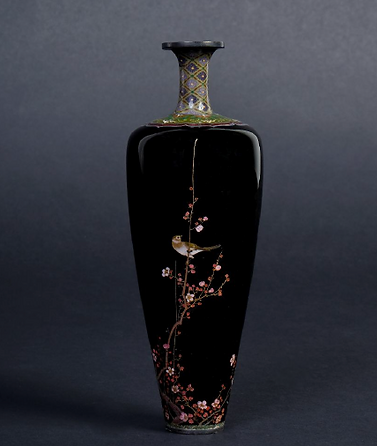
Japanese, late 19th or early 20th century, Porcelain with cloisonné enameling, 6 2 in. (15.2 5.1 cm). Flint Institute of Arts (Flint, Michigan).
03
Porcelain and Cloisonné Enamel Vase
Cherry blossoms are a popular motif in Japanese art and traditionally have been considered the symbol of Japan. These flowers are also associated with the Buddhist belief in the transience, or fragility, of life. Falling blossoms sometimes represent the souls of fallen warriors. Perched atop the branch of cherry blossoms is a Japanese Chidori, or Plover bird. Chidori are traditionally symbols of perseverance and springtime, as well as symbol of the warrior class; According to popular myth, famous hero Yamato Takeru transformed into a chidori upon his death. Thus, a gentle image of springtime instead becomes an elegant yet solemn acknowledgement of the
strength and loss of fallen soldiers.
The design is done in cloisonné enamel, a technique where thin metal wires and soft pieces of colored glass, or enamel, are used to create designs. Cloisonné enamel was first introduced to Japan by the Chinese. Japanese cloisonné enamel water droppers, writing sets, samurai sword guards and more became popular in the 16th century. However, it was only during the Meiji period (1868 – 1912 CE) that cloisonné enamel was applied to ceramic works, like this porcelain
vase. Renowned enamelist Tsukamoto Kaisuke is credited with developing the technique for ceramic cloisonné enamel design.
04
Circular Box with Cover
This gold and bronze box from the Meiji period (1868 – 1912 CE) features a cover decorated with rolling hills and tall mountains. In Japanese culture, mountains, or yama, are often seen as a place where the human world and the divine world meet. Early Japanese myth describes the gods descending from heaven onto mountain peaks. In the Edo period, mountains became common pilgrimage sites.
In the Meiji period, trade with the West resulted in an increase in the production of decorative objects for export and domestic consumption. By including the yama motif on the box, the artisan may have intended to display quintessential Japanese culture and aesthetics to a global
audience. Gold in particular became very popular across all mediums of art. With the end of the Edo period samurai culture, metalworkers found new trade in the production of decorative metal items, like this box.

Circular-shape box with cover, Japanese, 20th century, ca. 1900, Meiji Period (1868–1912), Gold and gold-bronze. Flint Institute of Arts (Flint, Michigan).


Research Methods:
All research used to write these object labels was completed during my time at the Flint Institute of Arts. As an intern, my job was to compile research on the Japanese Decorative Arts Collection –– at the time, the collection had no information available except for the materials, date of production, and limited notes on provenance. My research on the collection was done completely from "scratch." For more information on my sources, research reports, and more, click the links below.